

As humanoid and physical-AI robots become more capable and dexterous, efficient and reliable power delivery has emerged as a critical design challenge. Charge pump–based converters enable compact, high‑efficiency power solutions for space‑ and thermally‑constrained subsystems, such as the dexterous robotic hand.
Robotics power distribution chains
Robotic power distribution architectures continue to evolve to achieve the best balance of efficiency, power dissipation, thermal performance, safety, and system cost.
Figure 1 shows a distributed architecture suited to humanoid robotics. The battery voltage is converted to an isolated, regulated system 48V bus using the Murata MPQ700 quarter brick series – capable of supporting 700W with an input voltage range of 36-75V. This architecture simplifies the overall safety strategy by allowing downstream converters to remain non‑isolated, while also delivering a clean, low‑noise, and tightly regulated bus operating below the Safety Extra Low Voltage (SELV) limit. The improved power quality benefits electromagnetic interference (EMI) performance and helps to ensure robust, error‑free data communication across the robot.
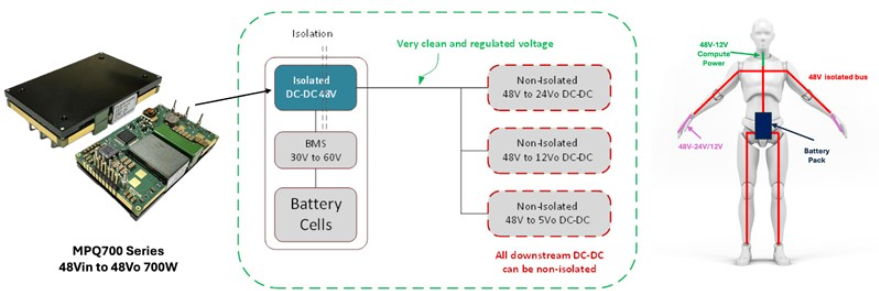
Figure 1: Isolated bus distribution – stable and clean, isolated 48V bus
Figure 2 shows a generic power train for a humanoid robot which can be converted to lower voltages supporting the joint motors, sensors, and control systems.
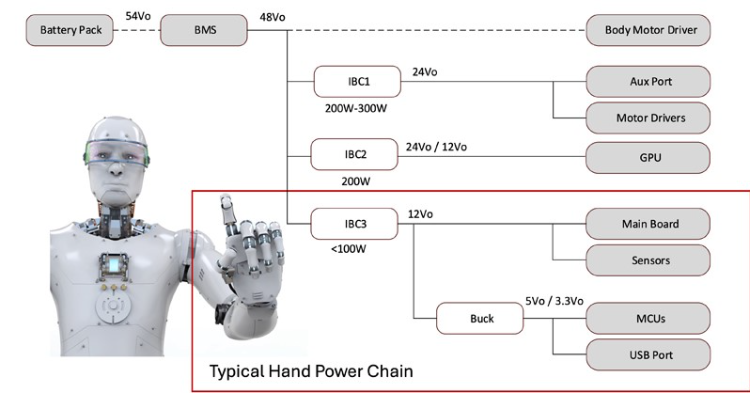
Figure 2: Humanoid robot – typical power train using a regulated, isolated 48V bus
The dexterous hand – power delivery
The dexterous robotic hand represents one of the most complex and technically demanding elements in physical AI and humanoid robotics systems. Power delivery to the hand and joint area must be high efficiency with minimal power dissipation, compact size, and low-profile to fit within the forearm area. Additionally, power conversion devices must be shock and vibration proofed. Large magnetic inductor components are vulnerable to damage during rigorous activity.
Typically, the humanoid wrist and hand joint use miniaturized brushless DC permanent magnet motors supplied from a lower input voltage, 12V or 24V. Typically, the wrist would be around 200W continuous power consumption with transients around 400W, while the hand would typically be 100W continuous with 200W power peaks.
High‑efficiency conversion from the 48 V system bus to 24V or 12V is therefore essential.
Using charge pump, switch-capacitors conversion instead of traditional buck converters
One approach is to use a traditional buck switching regulator (Figure 3). However, this method presents several disadvantages in space‑constrained robotic hands:
- Lower efficiency and higher power dissipation, particularly if space and height are limited.
- Large output inductor, if it fits in the space. Care is required to mount and secure the inductor to prevent mechanical shock and damage.
- EMI with surrounding electronics, particularly high-speed data communication paths.
The EMI can be significantly worse in higher voltage buck converters as the Vx node (Figure 3) swings between VIN (48 VIN) and ground. However, the actual voltage spike at Vx is much higher due to the reverse leakage of the inductor and board parasitics, often closer to 100V peak.
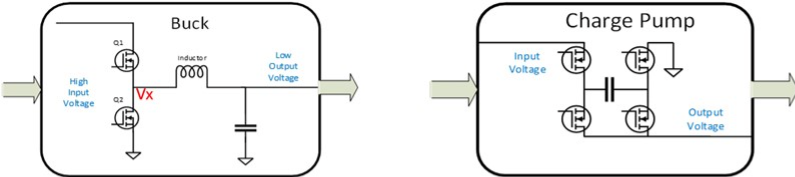
Figure 3: Traditional buck converter versus charge pump, switched-capacitor converter
Practical charge pump implementations
The implementation in Figure 4 uses the PE25208 charge pump device in divide-by-2 mode to generate 24V. In this case, two devices are connected in parallel to deliver over 240W (24V @ 10A) with efficiency around 98%. The key advantage of the design is the small solution footprint (15.5 mm × 30.8 mm) and the low-profile 2.7–mm height. This can be further reduced by around 20% with a 1–mm top-side component height by placing components on both sides of the board.
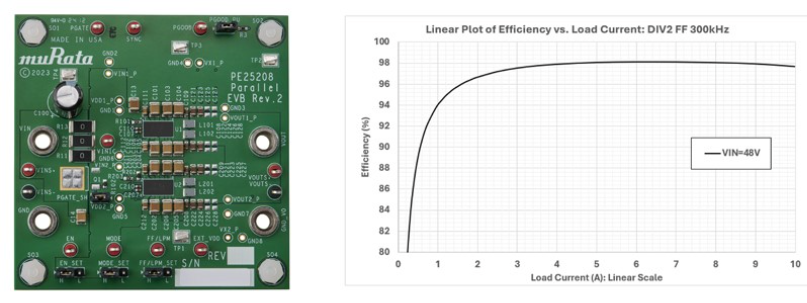
Figure 4: Two PE25208 modules connected in parallel with efficiency data recorded at 48VIN
The PE25304 is a charge pump module with all external passive devices included in the same LGA package (11.5 × 9.5 × 2.1 mm). The PE25304 has an input range of 20V to 60V and can deliver 6A @ 12V output from a single device. In Figure 5, two PE25304 modules are connected in parallel to deliver around 140W of power. In this example, the two PE25304 modules are placed on a carrier board with the dimensions and pinout of a traditional 1/16th brick module. The efficiency peaks at around 97% at 10-12A (around 140W).
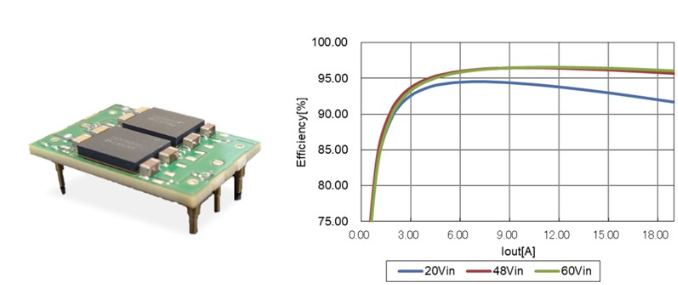
Figure 5: Two PE25304 modules connected in parallel capable of delivering 140W at around 97% efficiency
In summary, as humanoid robotics and physical AI systems become more advanced, power conversion solutions must deliver exceptional efficiency, power density, and reliability. Charge pump technology offers a compelling alternative to traditional buck conversion, enabling compact, low-profile, and highly efficient power delivery for space-constrained applications such as robotic hands and joints.